Push-to-open cabinet door not working? Causes and fixes
Handle-less doors depend on two parts working together: a hinge that does not pull the door shut, and a latch that holds the door closed and pushes it open. Almost every push-to-open problem comes from a mismatch between the two, the wrong latch force, or a gap set too wide. Here is how to find the cause.
Short answer
- Door will not open: the latch is too far from the door, or a spring hinge is pulling against it. Use a spring-free or push-open hinge and adjust the latch so it touches the closed door.
- Door will not stay shut: a rubber-head latch on a spring-free hinge has nothing to hold the door. Use a magnetic head.
- Door opens too little: latch force too low for the door. 23 N small doors, 30 N standard doors, 35 to 40 N tall or heavy doors.
In this guide
How push-to-open works
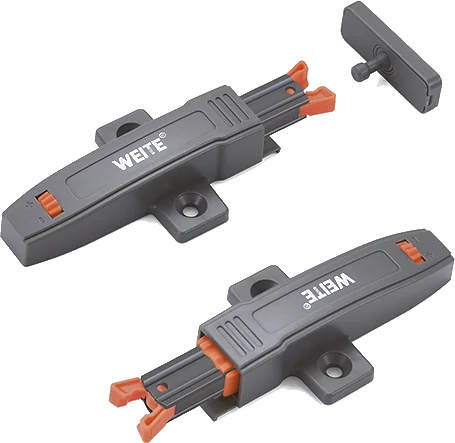
A push latch is a spring-loaded plunger with a magnetic or rubber head. Press the door, the plunger fires and the door swings open by 40 to 50 mm, enough to take it by the edge. Close it and the latch holds it. The hinge must not fight this: a normal self-closing hinge pulls the door shut and cancels the push. That is why push-to-open doors use a spring-free hinge such as the 6920, or a push-open hinge such as the 7551, which opens on a press and still closes softly.
Problems and fixes
| What happens | Likely cause | Fix |
|---|---|---|
| Nothing happens when you press the door | Latch head does not reach the door, so the press never triggers it | Adjust the latch towards the door until the head touches the closed door. WEITE latches have 5 to 7 mm of depth adjustment, and the 7427 triggers with a 1.6 mm door gap. |
| Door opens a little, then closes again | A self-closing hinge pulls the door back | Replace the hinges with spring-free hinges (6920) or push-open hinges (7551). |
| Door will not stay closed, or drifts open | Rubber-head latch used with spring-free hinges | Rubber heads rely on the hinge to keep the door shut. With spring-free hinges use a magnetic head, which holds the door on its own. |
| Door opens only a crack | Latch force too low for the door size or weight | Move up a force class, or fit two latches on a wide door. |
| Door pops open when bumped, by a draught or by a child | Magnet hold is not a lock | Use a self-locking opener such as the 7553: a mechanical claw grips a striker on the door, and only a push releases it. |
| Latch triggers when the next door is pressed | Doors touching, or latch pre-loaded | Check the gap between doors with the hinge sideways screw, and back the latch off slightly. |
Choosing latch force
Spring force, in newtons, is the main specification of a push latch. Too weak and the door hardly moves; too strong and the door bangs open.
| Door | Force | WEITE examples |
|---|---|---|
| Small doors and flaps | About 23 N | 7428 |
| Standard kitchen and wardrobe doors | About 30 N | 7427, 7542, 7022 |
| Tall or heavy doors | 35 to 40 N | 7556 (35 N), 7530 (40 N) |
Two latches on a wide door work better than one strong latch, because the door opens straight instead of twisting.
Where to fit the latch
- On the opening side, away from the hinges, where the push has the most leverage.
- Near the top or bottom corner of the door, where the hand naturally presses, rather than in the middle of a tall door.
- Surface-mount latches screw to the cabinet; the 7556 slides onto a rail so it can be swapped without tools; the 7542 hides inside a 10 mm bore in the side panel and shows only its head.
Drawers and tall doors
For drawers, do not combine a door latch with soft-close slides: the damper pulls the drawer back against the latch. Use push-open slides instead, the 7009 ball-bearing or the 7003 and 7010 undermount, and the whole kitchen works without handles. For tall wardrobe doors up to 2700 × 600 mm and 25 kg, the 7555 opens the door on a push and closes it softly from any angle; it works with spring-free hinges.
Questions buyers ask
Why will my push-to-open cabinet door not open?
Either the latch is too far from the door to be triggered, or a self-closing hinge pulls the door back. Adjust the latch so it touches the closed door and use spring-free or push-open hinges.
Can I use push latches with normal soft-close hinges?
Not with standard self-closing hinges, which pull the door shut. Use a spring-free hinge such as the WEITE 6920 with a latch, or the 7551 push-open hinge.
Magnetic or rubber head: which one?
A magnetic head holds the door shut on its own and is the one to use with spring-free hinges. A rubber head is quieter and is used where a self-closing hinge keeps the door shut.
How strong should a push latch be?
About 23 N for small doors, 30 N for standard kitchen and wardrobe doors, 35 to 40 N for tall or heavy doors. Use two latches on wide doors.
Can push-to-open work on drawers?
Yes, with push-open slides such as the WEITE 7009, 7003 or 7010 rather than a door latch on soft-close slides.
Building handle-less kitchens?
WEITE supplies the whole set from one factory: push latches, self-locking openers, spring-free and push-open hinges, and push-open slides.